Construction Business Owners, Beware: Your Top-of-Funnel is Invisible
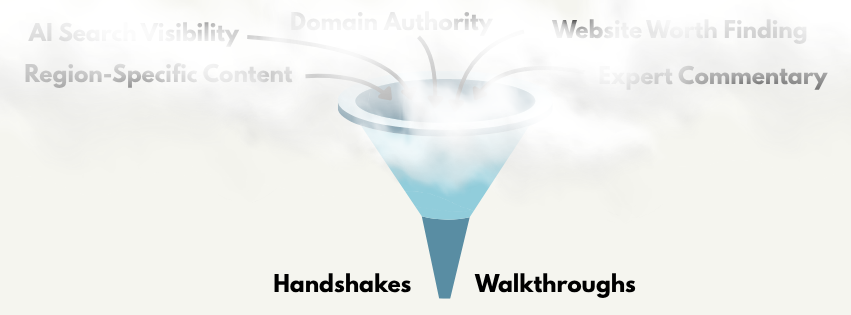
If you're not familiar with the word "funnel" in a marketing context, give me ten seconds. A funnel is just a shape: wide at the top, narrow at the bottom. At the top are a bunch of people who have heard of you. At the bottom are a few people deciding whether to hire you. Every business has a funnel. The question is whether you're feeding yours.
Michael Paladino has been in the scaffolding business for over 45 years. He knows his competitors. He knows who shows up on the walkthroughs, who bids the same jobs, who's union and who isn't. When I asked him for a list of competitors, he gave me one without hesitating. Then he waved off a few names and said, "We never see those guys."
That's when I told him: those are the ones I'm worried about.
Here's what you can see: the walkthrough, the bid, the handshake, the contract. You know who's in that room with you. What you can't see is the top of the funnel: who's getting the call before the walkthrough happens. Who's showing up when a 28-year-old project manager at a GC firm you've never worked with Googles "union scaffolding contractor NYC" at 9pm. Who's getting added to bid lists you don't even know exist yet.
That's the top of the funnel, and if your web presence is invisible, so are you.
"GCs don't scroll Instagram looking for scaffold subs. Followers don't equal contracts."
Michael came to me thinking he needed social media. A member of his team was already skeptical. Smart. I showed up to our first conversation with a slide that said, in plain terms: GCs don't scroll Instagram looking for scaffold subs. Followers don't equal contracts.
I warned him I was joining the resistance against the social media angle.
He shrugged, smiled, and said, "All right. Tear me apart." He's my kind of client.
The answer isn't social media. It's not ads. It's not even a flashy new website, necessarily. It's being findable when the right person is looking.
And here's what I want you to feel for a moment, because I think it matters: you already live with enough unpredictability. Weather delays, an equipment breakdown, a foreman who calls in sick the morning of a pour. A padded timesheet you didn't catch until payroll already went out. Construction is a world where something unexpected is always waiting around the corner, and absorbing it gracefully is part of the job.
Marketing doesn't have to work that way. Not if you do it right.
A few targeted blog posts. A Google Business profile that isn't three years stale. Service area pages that tell search engines and AI you exist in the markets you're trying to win. Content that shows up when someone Googles your competitor's name and finds you instead. This is not complicated, it doesn't require a massive budget or a marketing department, and the timeline is predictable. You'll know what's being done, when, and why. You'll have a log of every hour. No surprises. No black box.
I've got you.
"I treat my clients the same way they treat their projects: I create a detailed plan and timeline, and I follow it."
I got punished once for caring too much about customers. A previous employer called it "enmeshment." I called it my job. I left, started my own practice, and decided the clients I want to serve are people who do honest work and shake hands and show up. Construction fits that description better than any industry I've worked in. You can't BS a scaffold erection or an elevator shaft, or those shortcuts will come to a head and blow up in your face.
So I treat my clients the same way they treat their projects: I create a detailed plan and timeline, and I follow it. And while I do face an occasional software glitch or internet outage, hiring me is an extremely safe call. No equipment breakdowns, no weather delays, and absolutely no mystery regarding how I spent my time. For the first six months, I log every hour and share the log with you.
Here's a sample six-month action plan, built for a fictional masonry company in Layton, Utah. I wanted to show you exactly what this looks like before you spend an hour on a call with me.
Let's chat for an hour, and I will bring every ounce of my empathy to the conversation. It's an honest conversation about whether we're a fit. If we're not, you'll leave with good resources and probably a referral to someone who can serve you better.
In fact, if I do think we're a fit, I might offer to put you in touch with others who I've referred elsewhere. They'll tell you: I'm here to serve you, whether you become a client or not.
That first hour is always free. I'm genuinely looking forward to learning about your business.